The French put a high value on being polite. In France, like every culture, there is an understood code of conduct and etiquette that is expected of everyone.
Part of what makes a culture or community is the fact that we do share a common set of rules for behavior. Throughout the world, those respective rules are taught to each of us from the time we are born and throughout our childhood. As adults, we are expected to know them and abide by them. They are ingrained in all of us.
The thing to remember is that etiquette and manners are not universal. Each country and culture has their own set. Sure, there tends to be enough overlap from culture to culture that we can find commonality, but it’s important to remember that what is considered polite and what is considered rude is subjective and cultural.
Sadly, too often we hear an American complain that the French are rude. Firstly, that’s a pretty broad and unfair assessment of “The French” as a whole. Secondly, when you travel to France why would you expect them to act like Americans?
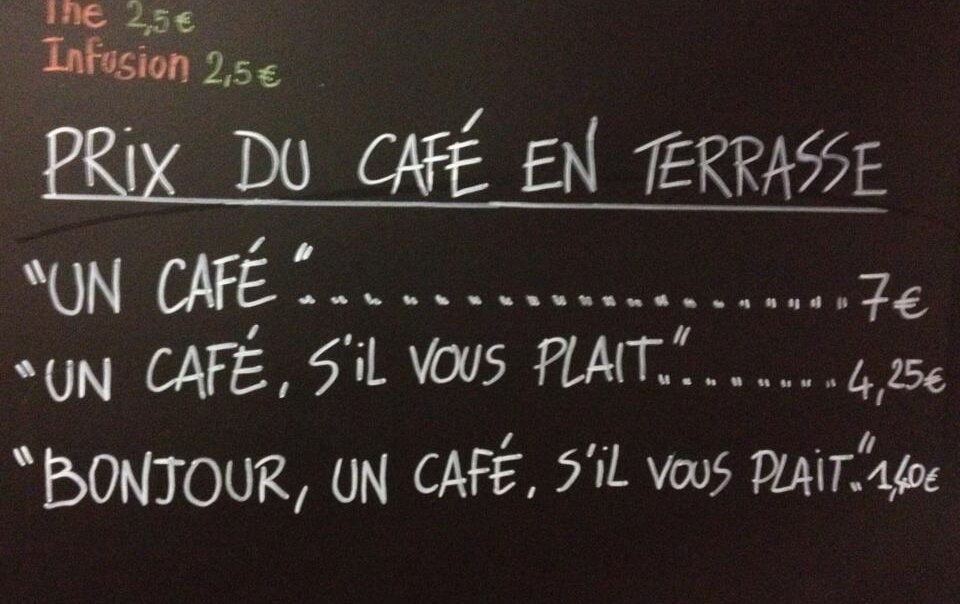
Image sourced from Gawker
Bare in mind that when the French encounter visitors that don’t appear to know or respect their version of etiquette, then they can be confused or offended by our behavior. This Gawker article, and the related image, illustrate how exasperated the French can become with the rudeness of tourists.
It boils down to a misunderstanding of how we each view the world and the importance of realizing that we should all follow the cardinal rule: “When in Rome, do as the Romans do”.
Below are a few books that I can recommend if you are visiting France. Whether it’s your first visit or your a frequently visitor, you’re sure to learn something interesting and helpful.
Taking a little time to learn about the culture and etiquette of the place you are visiting will go a long way toward helping ensure that you have the most positive experience possible.
When traveling to Paris, you’re pretty much guaranteed to have some fantastic meals. It’s hard not to. The restaurants, the bistros, the cafés, oh my! And who doesn’t love exploring the wide variety of food shops to gather items for a delectable picnic in one of Paris’ lovely parks or gardens? You really can’t go wrong.
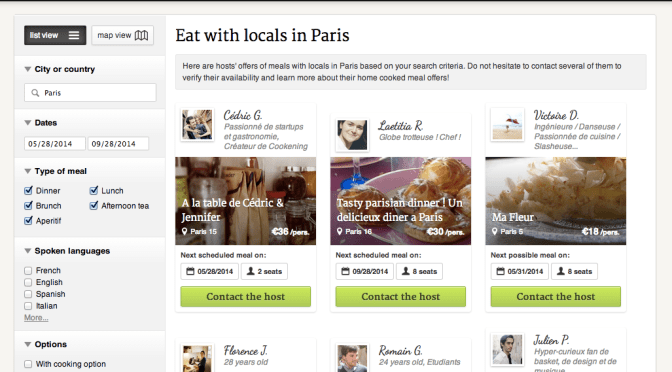
As independent travelers, we love to explore on our own and at our own pace, but sometimes it would be great to socialize and grab a meal with some other people. Easier said than done, right? What if you don’t know anyone in town? How do you meet locals and make fast-friends?
The answer is: Supper Clubs. There are a number of websites geared toward friendly locals that offer home cooked meals to travelers. It’s a little like Airbnb for meals. The locals create a profile, describe themselves, the type of meals they can provide, the languages they speak, and what they like to talk about. The traveler simply reviews the profiles, finds someone they’d like to have dinner with, and makes a reservation with them. Prices vary, but generally aren’t much more than the cost of the evening’s grocery bill.
If you’re traveling outside of the US and you want access to a cell phone, without the risk of racking up a staggering phone bill, then you have a few options to choose from.
1) Go Global With Your Plan: This is an option if you’d like to use your own phone. Contact your wireless carrier and ask them to set you up with a global coverage plan for the length of your trip and then switch back to your regular plan when you return. This the most convenient, but the most expensive option.
3) Swap Your SIM Card: This is another option if you’d like to use your own phone and it is “unlocked”. Simply purchase a SIM card that works at your destination or worldwide. You can either order one online before you leave or you can purchase one upon arriving at your destination. If you choose the later, then you will need to research where to find these in your destination, but they can generally be found at a variety of locations such as cell phone kiosks and convenience markets.
4) Internet Phone: If you don’t require 24×7 phone services and you have a smartphone, then you might consider simply using your phone when you have an Internet connection. Both Skype and MagicJack Plus make that possible, MagicJack Plus requires a one-time hardware purchase, with Skype you buy credit or pay a monthly fee. Just create an account, download the mobile app to your phone, locate a WiFi connection, and make calls at no additional cost.
Paris is an ideal destination for a family vacation. To the French, family is sacred and they adore children. Families spend a lot of time out and about together, both nuclear and extended families. This is in large part because Parisian apartments are small by most American standards, unless you live in Manhattan, and they don’t have yards.
This limited ‘living space’ means that Parisians spend a lot of time enjoying the city’s countless parks, gardens and green spaces. They act as a type of second living room for the locals. When you are planning a trip to Paris, be sure to factor in time to relax and unwind while you enjoy the natural (and architected) beauty of these places. We find that picnic lunches, picnic dinners, or evening strolls are an inexpensive and enjoyable way to pass the time.
If you have kids in tow, then I recommend making time for a visit to one of Paris’ many playgrounds. Most neighborhoods have at least a small playground, but there are a few that are worth seeking out and they can be found not too far from the major attractions. It makes for a wonderful reward for the little ones after a long day of museum viewing or a much needed play and lunch break in between attractions. Here are some suggestions with nearby major attractions noted.
Conveniently Located Paris Playgrounds
1) Jardin des Tuileries, Place de la Concorde, 1e, M: Concorde, Tuileries
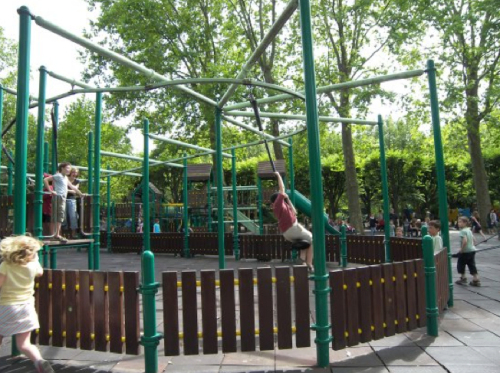
CC courtesy of MJ MacKinnon/Alex Smith
A large playground with multiple exits mostly composed of an enormous rope-and wood climbing structure starts with an 8-foot, almost entirely vertical ladder without open rungs. There’s a metal merry go-ground, lily-pad like jumping platforms, a slide, rope hammocks, and more. Nearby Attractions: Louvre, Tuileries Gardens, Place de Concorde
2) Jardin du Luxembourg, 6e, M: Odeon, Saint Suplice, Mabillon
CC courtesy of Travelpod.com
The garden itself is beautiful and vast with plenty to keep the kids busy. They can sail boats in the central pond, ride ponies, and run on the park’s winding trails. Most of the grass is off limits (Pelouse Interdite). The playground has an intricate system of climbing structures and slides. There’s only one exit. There is a cost of 2.60 euros for kids over 18 months, 1.60 euros for adults. Nearby Attractions: Luxembourg Gardens, Saint-Sulpice Church, Cluny Museum, Montparnasse Tower, Montparnasse Cemetery.
3) Jardin des Enfant aux Halles, Forum des Halles, 1e, M: Les Halles
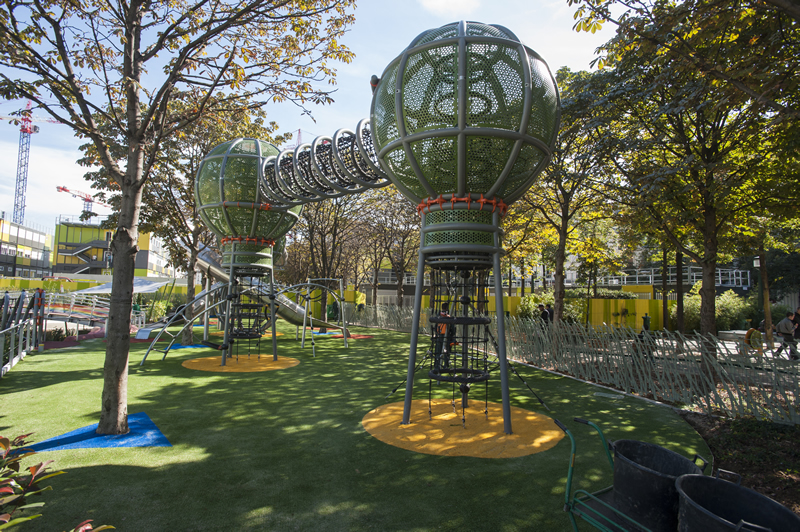
CC courtesy Mairie de Paris
This is a fantastic adventure playground for 7- to 11-year-olds with great tunnels and slides. The children are supervised by professional child-carers, so you can have a bit of a break yourself. Kids are limited to 1 hour and there is a 100-kid capacity. You must place your name on a list to reserve a time, but there is no entry fee. Nearby Attractions: Louvre, Pompidou, Rue Montrorgueil, Musée des Arts et Métiers.
4) Parc du Champ de Mars, Quai Branly – Avenue de la Motte Picquet, 7e, M: École Militaire
CC courtesy of Wikimedia
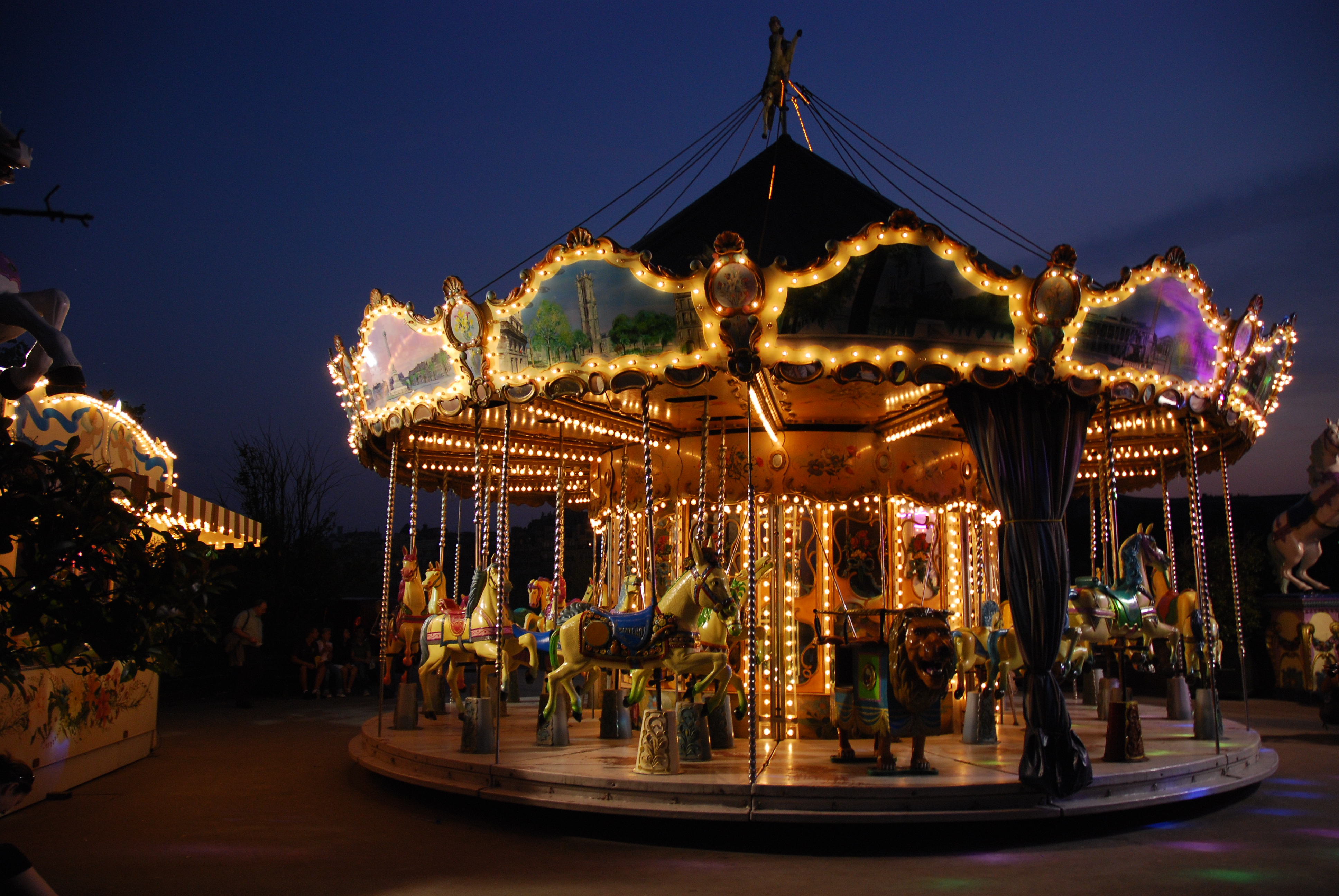
The Champs de Mars has a small playground perfectly situated close to the Eiffel Tower with an elaborate climbing structure, slide and sandbox. Here you find a carousel, puppet theater, pony rides, basketball and music. Nearby Attractions: Eiffel Tower, Trocadéro, Napoleon’s tomb at Les Invalides.
5) Suzanne Buisson public garden, 7 Bis Rue Girardon, 18e, M: Lamarck Caulaincourt or Abbesses
CC courtesy of Wikimedia
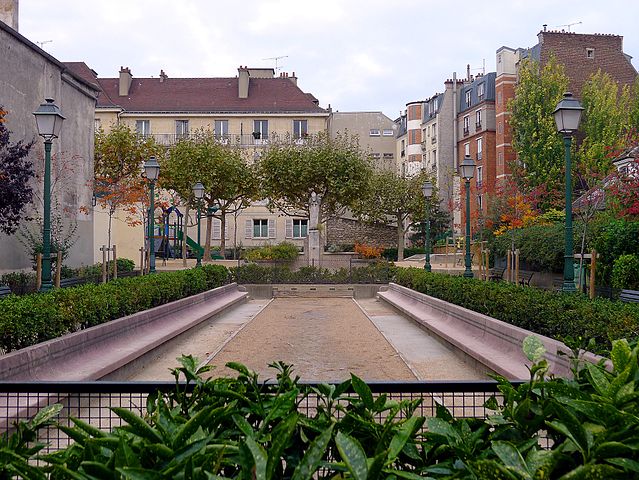
Hidden at the top of the Montmartre hill, this public garden has a very nice petanque area. It offers peace and quiet as there are very few people walking by. An area terraced in 1951 in art deco style it has a statue of St Denis in the centre of the garden, a children’s playground and fresh open space and benches to be still for a Montmartre moment. Nearby Attractions: Montmartre, Sacré-Coeur, Musee de Montmartre, Place du Tertre
We enjoy the luxury of being homebodies abroad. Our preference is to find a comfortable vacation rental in our chosen destination and then live like a local. Sure we enjoy visiting the top sights, but we also enjoy taking part in the simple pleasures of daily life in a foreign country.
Over the years we’ve been lucky enough to take two separate one-month-long vacations in Paris. One of our goals was to spend many leisurely afternoons picnicking in public parks throughout the entire city.
Paris has a LOT of parks and gardens. We’ve been able to visit 23 of them. There are several that are on listed in most guidebooks, such as Jardin des Tuileries, Jardin du Luxembourg, Parc du Champ de Mars, but many of there were farther afield and less traveled. Here is a list organized by Arrondissement.
Our Favorite Paris Parks
Jardin du Palais Royal, 38 rue du Montpensier, 1e, M: Louvre, Place Vendôme
Jardin des Tuileries, Place de la Concorde, 1e, M: Concorde, Tuileries
Jardin des Halles, Forum des Halles, 1e, M: Les Halles
Place des Vosges, Place des Vosges, 4e, M: Chemin Vert
Jardin des Plantes, 57 Rue Cuvier, 5e, M: Austerlitz, Censier Daubenton
Jardin Tino-Rossi, 8 Quai Saint-Bernard, 5e, M: Jussieu, Quai de la Rapée
Jardin du Luxembourg, Jardin du Luxembourg, 6e, M: Odeon, Saint Sulpice, Mabillon
Parc du Champ de Mars, Quai Branly – Avenue de la Motte Picquet, 7e, M: École Militaire
Parc Esplanade des Invalides, Avenue du Maréchal Gallieni, 7e, M: Invalides
Parc Monceau, Boulevard de Courcelles, 8e, M: Monceau
Parc de Belleville, 47 rue des Couronnes, 11e, M: Couronnes, Pyrénées
Parc de Bercy, 41 rue Paul Belmondo, 12e, M: Bercy
Bois de Vincennes, Bois de Vincennes, 12e, M: Porte Dorée
Parc Floral, Esplanade du château de Vincennes – Route de la Pyramide, 12e, M: Château de Vincennes
Parc Montsouris, 2 rue Gazan, 14e, M: Porte d’Orléans
Parc André Citroën, 2 rue Cauchy, 15e, M: Balard
Parc de Bagatelle, 42 route de Sèvres à Neuilly, 16e, M: Pont de Neuilly, Ranelagh
Bois de Boulogne, Bois de Boulogne. 16e, M: Porte Maillot
Jardin d’Acclimatation, Bois de Boulogne. 16e, M: Les Sablons
Jardins du Trocadéro, Place du Trocadéro, 16e, M: Trocadéro
Parc des Buttes-Chaumont, Rue Manin, 19e, M: Buttes-Chaumont
Parc de la Villette, 211 avenue Jean Jaurès, 19e, M: Porte de Pantin
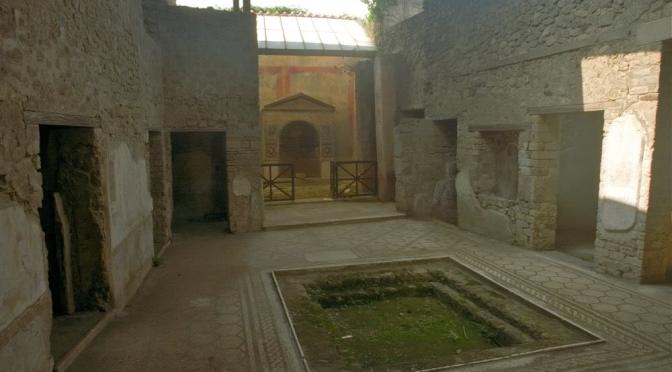
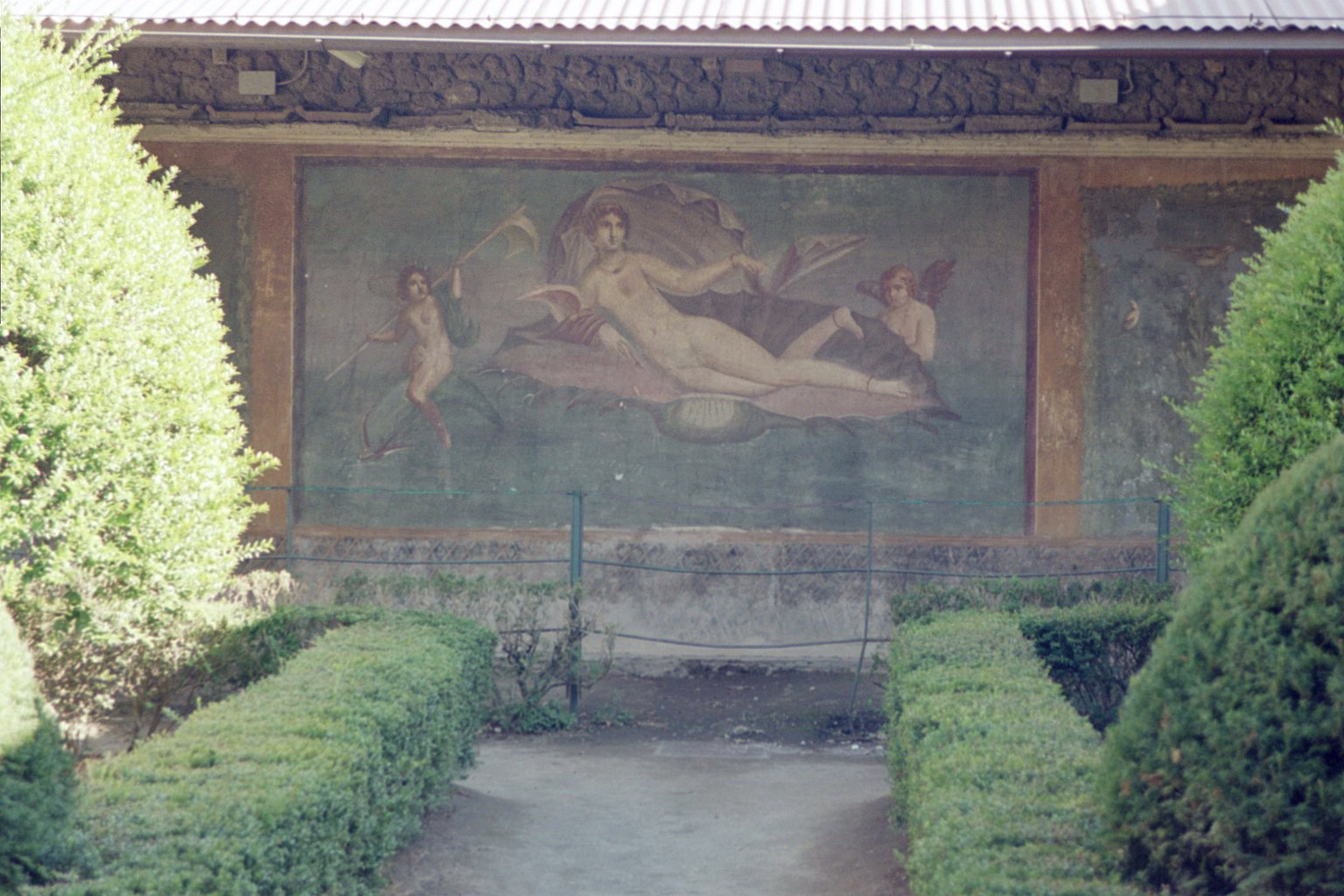
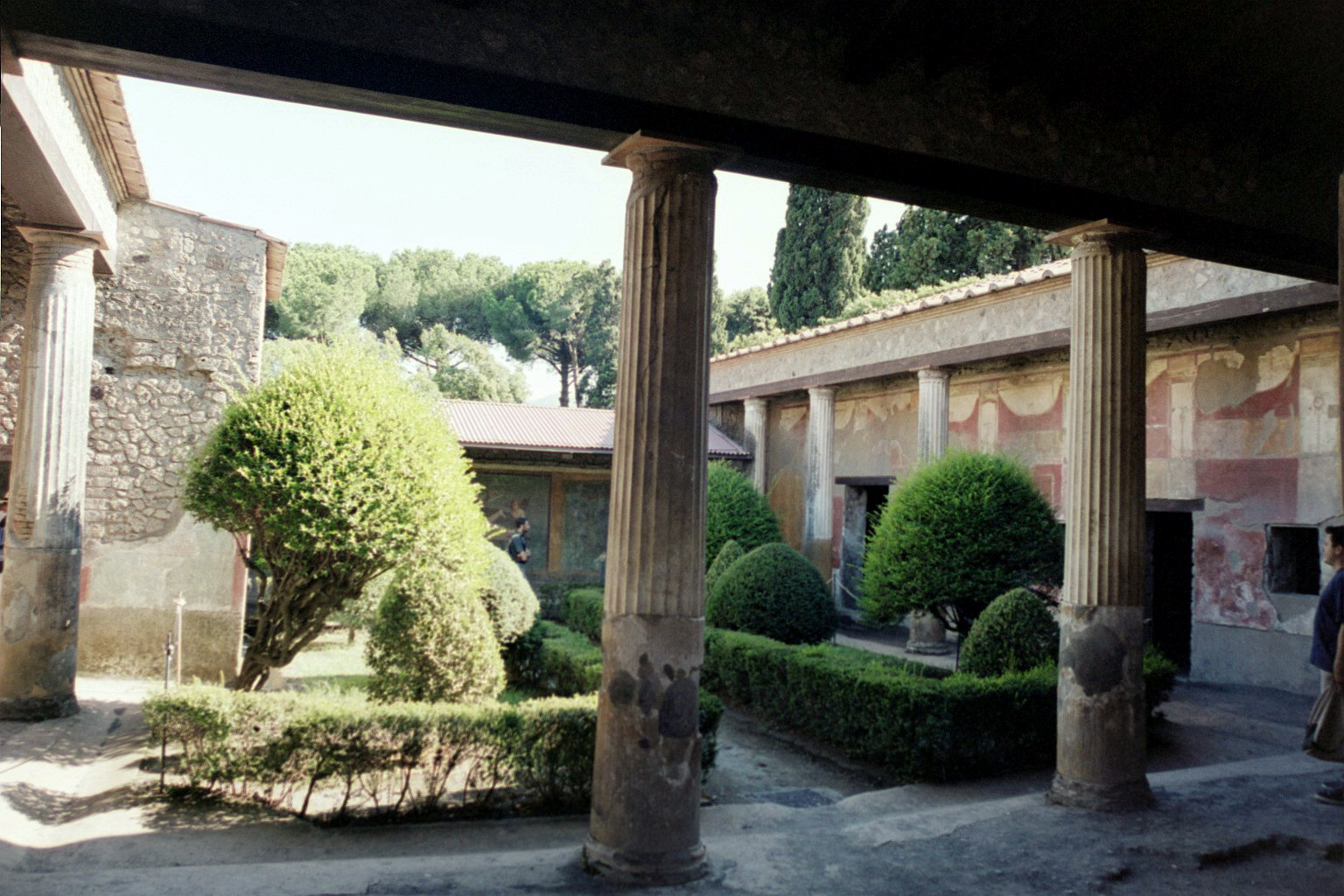
We visited Pompeii for the first time about a decade ago and to this day it remains one of the most surreal and awe-inspiring travel experiences that I’ve ever had. It felt like a waking dream to wander freely though a town that was inhabited nearly 2000 years before. As I entered the homes and businesses of people long dead and saw the remains of their daily lives frozen in time, I felt oddly connected to them and thankful to be immersed in the experience. Pompeii is a precious window into the past and a remarkably preserved one at that.
When Pompeii was destroyed by a volcano in August of 79 A.D., it was a resort town inhabited by wealthy Romans who were known for lavish spending on their homes. The evidence of this decadence can still be seen. As you explore the town you will happen upon colorful frescos, fountains, mosaic floors, courtyard gardens, and even indoor plumbing.
You can visit Pompeii’s restaurants, bakeries, public baths, amphitheater, and even brothels. There is still graffiti writing on the walls. It’s both fascinating and a bit unsettling to be granted such an intimate view of the city and it’s inhabitants.
It’s a cold December day here in Portland, Oregon. There is even a little snow on the ground, which isn’t unheard of, but fairly uncommon. Christmas is only weeks away and as many prepare for the holidays I’m sure Christmas music plays in the background.
In contrast, I’m not quite ready for the cold and I haven’t yet begun the transition into winter. I will shortly, I love the holidays, but today I dream of warm weather and tropical drinks. I can’t help but hear the Caribbean’s siren song. It reminds me of an infectious calypso album that’s a perfect accompaniment for my daydreaming.
Back in May I heard a review of Kobo Town’s second album,Jumbie in the Jukebox on NPR. It was one of those albums you hear and immediately love. A unexpected gem. I encourage you to listen to the song previews on iTunes. I’ll be surprised if you don’t want to buy it for yourself.
What the Critics Think
Kobo Town brings Neil Young’s angst and Jerry Dammers’s instincts to traditional calypso themes. His upcoming Cumbancha release is a pithy combination of social commentary, dubwise soca, and calypsonian wit. –The Village Voice
He’s a powerful singer and an impressive multi-instrumentalist, playing guitars, bass and percussion, and he’s helped by producer Ivan Duran, best known for his work with Garifuna singer Andy Palacio. There are echoes of soca, dancehall, ska and reggae here, along with sturdy brass work, and the lyrics are suitably intriguing. He praises calypso as a news medium, covers topics ranging from the death penalty to tourists who take photos of Caribbean poverty, and ends with an apocalyptic calypso with echoes of TS Eliot. Impressively original. –The Guardian (UK)
The music of the Toronto band can drift between classic Caribbean pop styles and even verge on hip-hop, but the singer’s perspective remains sharply focused, wry and witty. Jumbie in the Jukebox is a seductive invitation to musical time travel and one that’s hard to resist. –NPR’s All Things Considered
“I do not say there is no character as well-drawn in Shakespeare [as D’Artagnan]. I do say there is none that I love so wholly.”
—Robert Louis Stevenson
Many years ago I bought myself a copy of The Three Musketeers by Alexandre Dumas. I chose it from the shelves of Powell’s Bookstore primarily because of the description on the back. I remember the word “swashbuckling” jumping out at me. I was a little skeptical, but my curiosity was piqued and I thought it was worth a try.
To be honest, I found the first couple chapters a bit boring, but I kept reading and before long things started to get interesting, riveting even. It was the perfect blend of adventure, intrigue, history, romance, comedy and setting. It was, well, swashbuckling. I was hooked.
I soon learned that The Three Musketeers was actually part of a series called The d’Artagnan Romances and that it was originally published in 1844 as a serial in a Parisian magazine. I went about tracking down the full series and I read them all voraciously. I looked forward to reading on my commute, at lunch, and before bed every day. Many nights I stayed up far too late reading “just one more chapter”, and then “just one more”.
Since it was written as a serial, just about every chapter ends with a cliffhanger. I was so enthralled by the characters, the places, and events that I simply had to see it all for myself. Here are just a few places you can visit on your own Musketeer Themed Tour of Paris.
Different publishers compile the serials in different ways, so I recommend sticking with the same publisher for the entire series to ensure that your reading experience has the proper continuity and flow. Another thing to note is that these books were originally written in French, so some translations are better than others. I personally enjoy the Oxford World’s Classics editions.
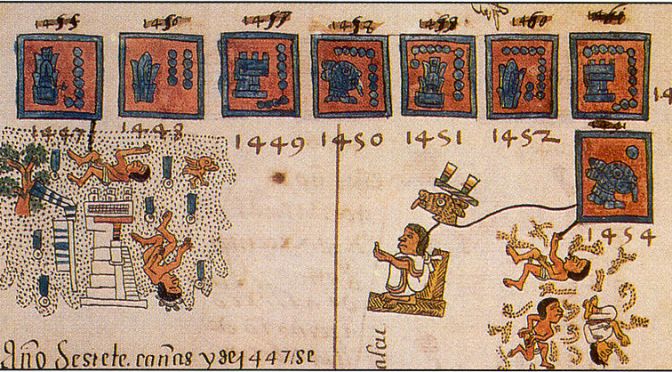
I came across a brief article today on the Past Horizons website noting that archaeologists at the site of Tehuacan in Puebla, Mexico believe they’ve identified a mid-fourteenth century shrine to the Aztec god Mictlantecuhtli (pron. Mict-lan-te-cuht-li) or ‘Lord of the Land of the Dead’.
Just last night I wrote a post about hosting my first Dia de los Muertos celebration, so I’d already been thinking about Mexico’s deeply rooted views that life and death are fundamentally interconnected. Continue reading The Afterlife and Human Sacrifice→
For Mexicans, death is as natural as life itself. It’s seen as an inevitable part of the natural cycle. Birth leads into life, and life leads to death. The worlds of the living and the dead are deeply intertwined, two parts of a whole.
Pre-Hispanic cultures believed that when someone died they went to Mictlán (Place of Death) where they more or less continued their existence. For example, if someone was a baker in life, then they were also a baker in death. This is why you see skeletons (calaveras) decorated to represent different personalities from all walks of life. They aren’t meant to be scary. Instead, they represent the playfulness of the Dead, as they mimic the Living. Continue reading Hosting Our First (Mostly) Authentic Dia de los Muertos Celebration→









 Meandering Family: Beyond the Nest