
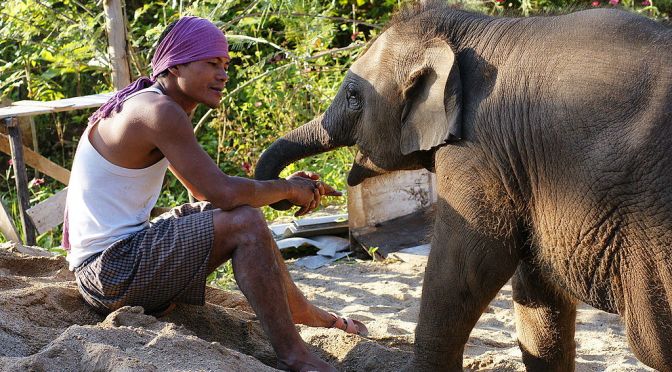
When we were planning our trip to Thailand, spending time with elephants was at the top of our list of things to do. And, here in Northern Thailand, there are abundant opportunities to engage with elephants. After lots of investigation, we settled on Baan Chang Elephant Park and had an amazing experience there.
Our one day Elephant Mahout training experience inspired me to find out a little more about mahouts and the role of elephants in Thailand’s tourist industry. It’s an interesting, complex topic – and an increasingly controversial topic, as well. During our initial investigations, we learned that, when choosing an elephant encounter, there is a lot more to consider than you might have previously considered.
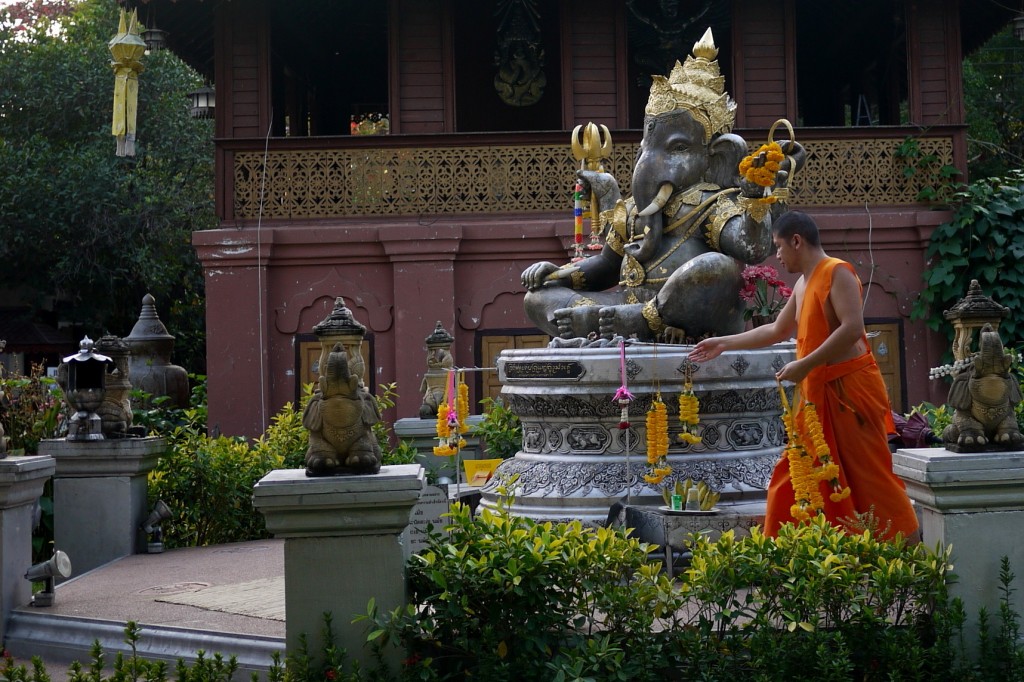
The relationship between people and elephants has existed for thousands of years in southeast Asia. In Thailand, the relationship became an integral part of the Thai culture, where elephants are revered for their important role in Buddhist and tribal folklore, Thai mythology, and Thai history.
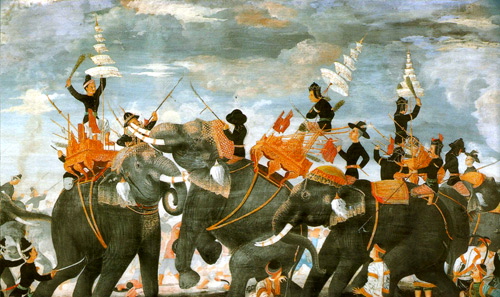
People domesticated elephants to help with heavy physical labor, similar to farmers in the west harnessing the power of a pair of oxen or a carthorse. The cultures of Thailand have since worked with elephants to help plow fields, log forests, assist in construction, and famously work as elephantry units (think cavalry) to carry Thai kings and their mahout warriors into war and help them secure victory. Asian elephants may be smaller than African elephants, but they are actually stronger, and their more gentle nature makes working alongside humans possible.
At the turn of the last century, approximately 100,000 domesticated elephants still lived in Thailand, virtually every large village had a number of elephants working in the logging industry or on farms. Elephants were a major contributor to a family’s income. Thailand’s current population of domesticated elephants is about 2,700, while estimates of the wild elephant population are between 2,000 to 3,000 animals.
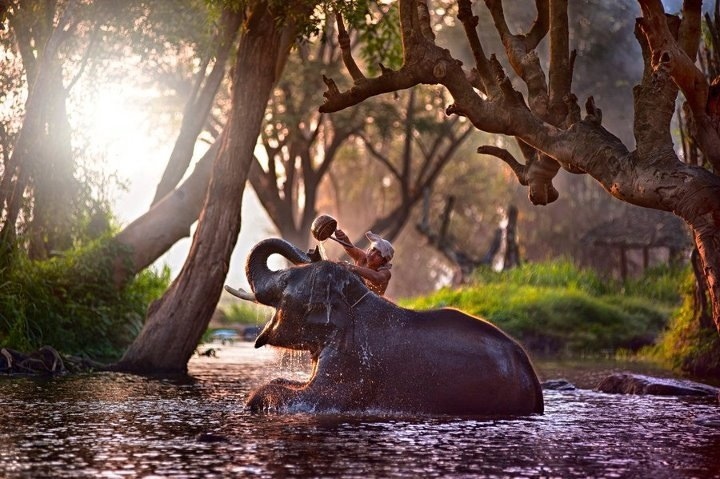
From the earliest days, those tasked with caring for and training elephants were called mahouts. Traditionally, mahouts are born into the vocation. The role and its specialized knowledge were passed down from father to son. As children, the mahouts were paired with an elephant and remained bonded with the animal for life. This relationship is considered to be among the strongest and most complex ever forged between humans and animals — the only one on the planet that can last an entire human lifetime. It is far deeper than merely that of a “trainer” or “keeper.” Mahouts often consider their elephants to be a family member.
Being a mahout is a serious commitment and a full-time job. They generally live and work side-by-side with their elephant and provide constant care and feeding in addition to training. Elephants sleep only 4 hours per day, drink an average of 32 gallons of water and eat an average of 220 kilograms of food each day. Additionally, frequent trips to a large water source is needed for bathing, because elephants are prone to overheating in the scorching Thai sun.
The mahout must have a keen knowledge and understanding of his elephant’s personality and moods. A skilled mahout can “read” his elephant and guide his elephant using around 70 commands combined with touches behind the ear.
Many onlookers mistake the mahout’s takaw (bull hook) for a sort of disciplinary tool or weapon to be used on the elephant, but its true purpose is to augment voice commands, if needed. The entire surface of the tool is used. The hook is used to grab and pull whereas the blunt end of the metal head and the wooden handle are used to push or prod. An experienced mahout will use the takaw gently to communicate instructions. While it can and does get used inappropriately by inexperienced or ineffective mahouts, a properly trained mahout would not use it with the intention to cause harm. Elephants are very intelligent and they have very long memories. Mistreating an elephant is not only irresponsible and cruel, it’s just not smart.
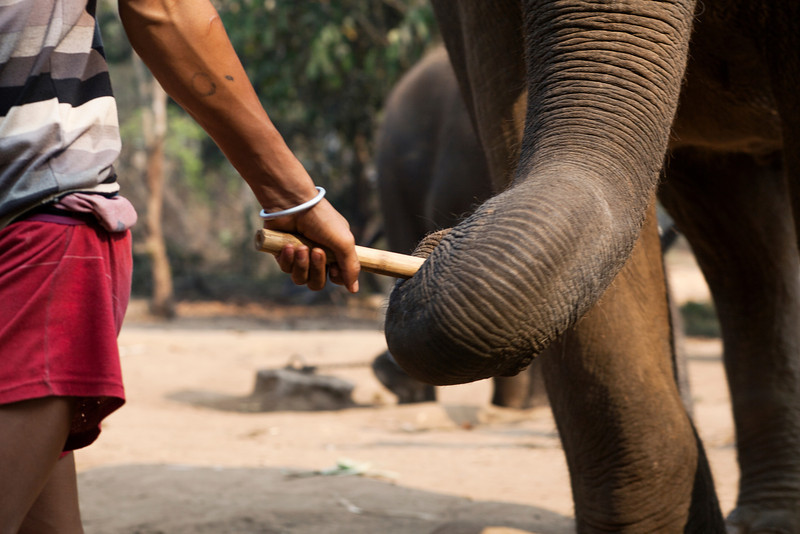
The mahout’s ability to guide and direct the elephant is vital. Although most elephants are extremely friendly, they can also be very unpredictable, especially if they are mistreated or not properly trained. For this reason, mahouts probably have one of the most dangerous jobs in all of Thailand. A strong bond and skilled training ensures the safety of the mahout, the safety of other humans nearby, and even the safety of the elephant .
Teak logging was banned by the Thai government in 1989, leaving thousands of elephants out of work and with no way to earn a legal income. Not only could mahouts no longer afford to maintain their beloved companions, they could no longer afford to feed themselves or their families. Countless mahouts saw no option other than to take their elephants to the city to earn (and often beg for) an income. How else do you provide 220 kilograms of food each day and support your family? Unfortunately, this meant that elephants were forced to walk long distances to reach city centers each day. Toxic exhaust fumes, polluted drinking water, unreliable meals, traffic, and excessive exercise all make for dangerous and unhealthy conditions.
Some may ask why the mahouts don’t simply set their elephants free to live naturally in the forests. Partly, it has to do with their mutual bond and that it’s the only way of life they’ve known – one that’s been handed down for generations, but it is also due to the elephant’s disappearing habitat. There is barely enough jungle left to support the wild elephant populations that exist now. Without adequate space and food sources, hungry elephants venture out to eat farmers crops. This leaves farmers understandably upset and can lead them to kill the elephants in order to protect their livelihood. It is also worth noting that although “domesticated elephants” aren’t truly “domesticated”, they are classified as livestock, like oxen or water buffalo – not as wild animals. As such, they are not protected under Thailand’s Conservation Act of 1992.
Given the situation, domesticated elephants need to be cared for, and that’s an expensive task. Enter tourism and elephant camps. Some animal rights groups have argued that tourists should not visit elephant camps, claiming it promotes cruelty. There are without a doubt camps that exploit or mistreat elephants. That is inexcusable and should not be tolerated. But, there are many more that seek to provide a humane refuge for these magnificent creatures and a livelihood for their mahouts and their families.
Elephant camps invest a huge amount of money in their elephants and their upkeep. A healthy breeding female is worth as much as 700,000 baht or US$22,000 – a huge amount of money in the smaller, rural economies where elephants live. It is not in their interest to mistreat their animals. The cost of rescuing, housing, feeing and caring for these elephants is enormous and cannot be done without ongoing revenue. When tourists visit these parks, they become more deeply invested in the elephants welfare and the ticket price ensure the animals will be cared for and valued. Many parks also educate visitors about the plight of the Asian elephant – both domestic and wild.

As the mahout way of life becomes more difficult to maintain, many have been forced to sell their elephants and seek work elsewhere or they may choose not to pass the vocation on to their sons. This is a sad loss. There is an art and a science to being a mahout. The wisdom and training that was once passed down through generations through daily hands-on training might eventually be found only in books and manuals. The loss of traditional mahout culture would leave a tremendous void. By definition their loss would be filled by less experienced recruits, some without the deep connection, understanding, and commitment to the elephants that their predecessors had. This lack of experience can lead to mistreatment and abuse.
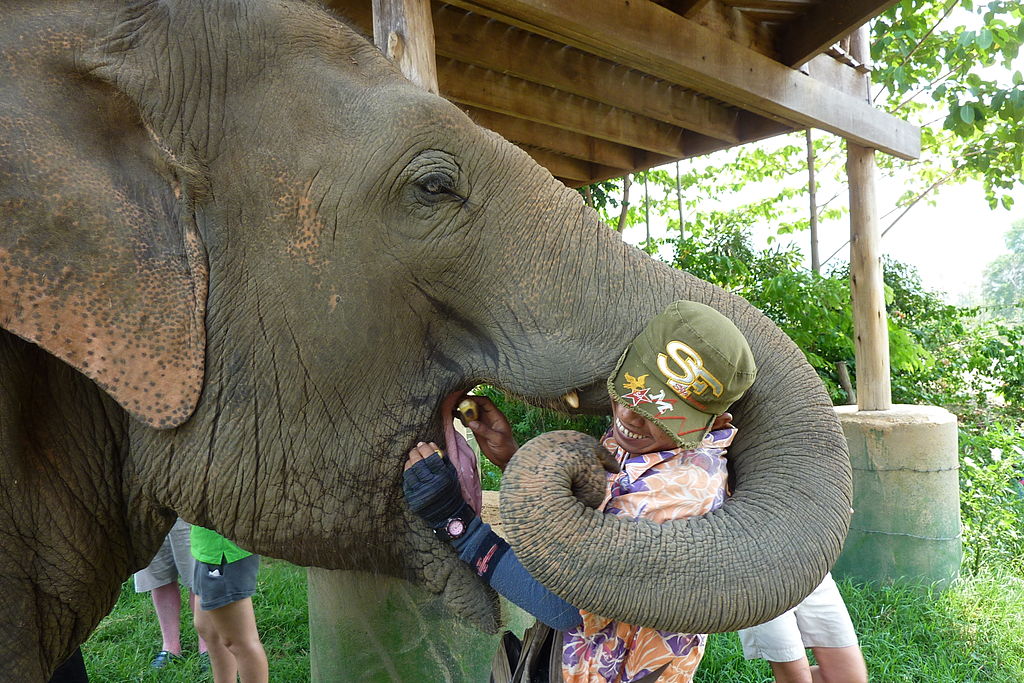
Personally, we believe that one benefit of the tourist dollar is to make the mahout lifestyle a viable option for those that choose to make it their life’s work. There is no doubt that work must be done to improve conditions for both wild and domesticated elephants. Decreasing habitats are a worldwide problem threatening numerous species. Increasing human populations that need to be fed and clothed and sheltered, continue to threaten wild habitats. Smaller, densely populated countries like Thailand, do not have vast tracts of land, like North America or parts of Africa, that can be set aside without significant disruption to the populations already residing there. Thailand has made considerable strides in trying to set aside wild areas and reducing ecological disruption in some area, and we think these efforts should be recognized and encouraged. We think that well maintained and humane elephant camps can fulfill a vital role at the interface between the wild and domesticated worlds, if they are encouraged.
 Meandering Family: Beyond the Nest
I really like your angle on this debate. Elephants are so controversial in Thailand and it’s difficult to know what to do. I’ve seen elephants in many countries and I distinctly remember seeing an elephant on the street in Bangkok in the 90’s! I felt so sorry for both the elephant and it’s trainer but I know the reality is that elephants are not pets but working animals. I’d rather they “work” at an elephant camp that educates tourists, than a circus of painting, running and jumping!
P.S. Was it painful going bare-back as elephants are huge animals? I’ve ridden elephants, camels and horses before but not bare, and knowing my luck, I’m bound to fall off due to anxiety!
Thank you. The issue is quite complex… especially if you love animals. Our feelings and thoughts ran the gamut as we read about the plight of elephants in Thailand and the various encounters and camps. I can say that our experience was incredible and we are so happy that we had the opportunity to spend the day at Baan Chang Elephant Park. As for riding bare-back, when you are sitting on the elephant’s neck it’s not as uncomfortable as it is awkward. I felt safely perched, but I couldn’t quite find a comfortable position. I actually found that sitting on back was more comfortable and a lot less wobbly. However, you need to be on the neck if you want to “drive” as you use your feet to tap the back of their ears in order to communicate directions (i.e. right, left, or forward). I’m hoping to visit the Elephant Nature Park next time. There they let the rescued elephants roam freely on the sanctuary. They don’t allow you to ride the elephants, but you can spend the day observing and learning about them and there’s still an opportunity to feed and bathe them.